
No more trimming
No more capping
No more cutting high grades
“It is unacceptable that there is no way to develop a mathematical theory or method to explain and justify the practice of miners of lowering high grades. The assumption that this is not feasible is an underestimation of the power of mathematics”
Miguel Armony, Ph.D.
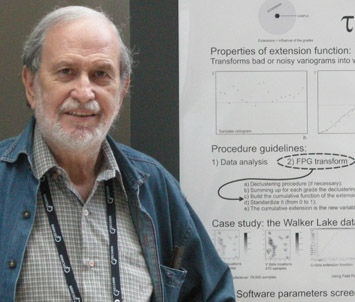
Miguel Armony
Field Parametric Geostatistics (FPG) is a theory that generalizes Classical Geostatistics replacing point variables by a transformed global variable and proposes a new method to solve problems arising from highly skewed data.
Gold grades estimation requires more than using solid geostatistical techniques. Mineral resources analysts have worked at several gold deposits and in all of them none of the mathematical methods was able to avoid manual interventions, such as cutting high grades for local estimation and using information beyond the data to infer the variograms.
Linear kriging methods fail to estimate local grades and local reserves for highly skewed variables due to three reasons:
- it uses only part of the available data information;
- it has no physical principles associated with the mathematical proceedings to minimize the problems;
- it works with continuous variables while data are discrete because of the limited precision of any equipment.
The techniques commonly used up to now to solve the highly skewed variables estimation problems were unsuccessful, unless mathematical rigor is abandoned. Even the method of multiple indicator kriging is not satisfactory.
Field Parametric Geostatistics (FPG) is a new framework that transforms noisy variograms into well-behaved variograms and justifies mathematically empirical procedures commonly used, such as trimming or capping arbitrarily very high values. The method, when applied to non-skewed variables, yields similar results to classic kriging.

Publications
- Field Parametric Geostatistics (2001)
Miguel ArmonyInternational Journal of Surface Mining, Reclamation and Environment - Logical basis of Field Parametric Geostatistics (2005)
Miguel Armony
International Journal of Surface Mining, Reclamation and Environment - FPG – Geostatistical rigorous solutions for highly-skewed distributions (2011)
Miguel Armony, Rochana S. Machado, João Felipe Coimbra Leite Costa and Jair Koppe
Proceedings of the 2nd International Seminar on Geology for the Mining Industry (Geomin 2011) - Field Parametric Geostatistics – Geostatistical Rigorous Solutions Dealing with Extreme Grades During Resource Estimation (2011)
Miguel Armony, Rochana S. Machado, João Felipe Coimbra Leite Costa and Jair Koppe
Proceedings of the 35th APCOM Simposium, 2011, Wollongon - Field Parametric Geostatistics – A Rigorous Theory to Solve Problems of Highly Skewed Distributions (2012)
Miguel Armony, Rochana S. Machado and João Felipe Coimbra Leite Costa
Geostatistics Oslo 2012